Chattel & Mobile Home Financing
Flexible, affordable financing solutions for manufactured and mobile homes — helping you achieve homeownership with confidence.
Tiny Home & Affordable Housing Financing Overview
1. Tiny Home Down Payments
- Typical range: 10%–20% of the purchase price for RV or personal loans.
- Builder financing: Often requires 20% or more down.
- Specialized lenders: Some may accept 3%–5% down depending on credit strength (e.g., FICO 720+).
2. Private Lenders / Chattel & Personal Loans
- Private lending: Often provided through specialized lenders or personal loans, including chattel loans.
- Financing types:
- Tiny homes on wheels: Usually financed as RVs or through unsecured personal loans.
- Tiny homes on foundations: May qualify for land–home mortgage structures.
- Loan terms: Typically range from 7 to 25 years.
- Unsecured loan amounts: Many lenders offer $5,000–$100,000 with best rates for excellent credit.
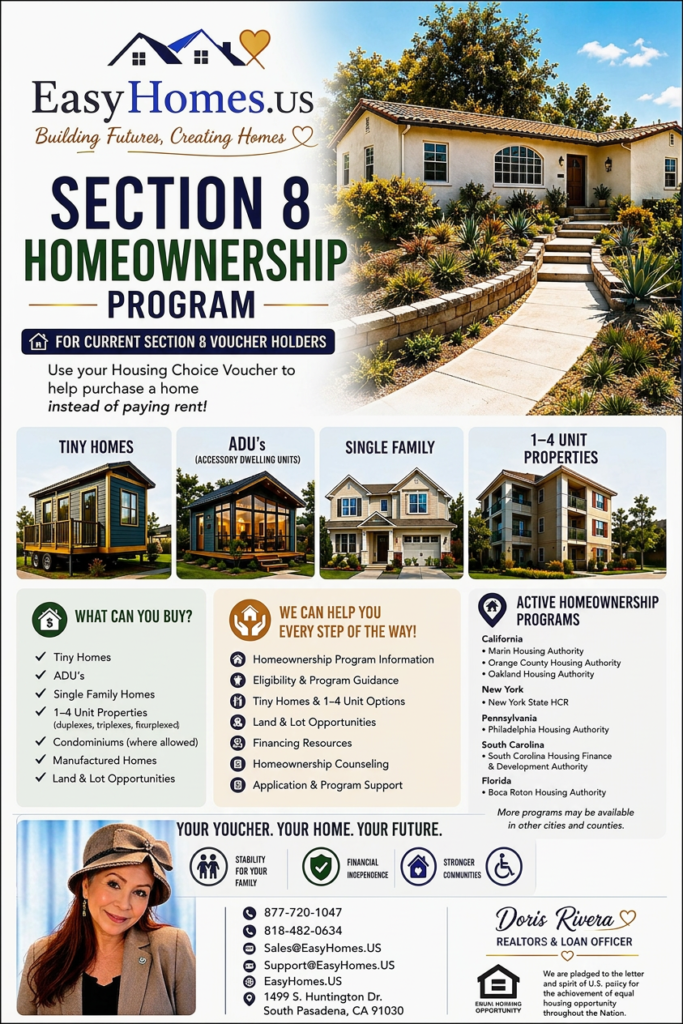
3. Section 8 Homeownership & No-Down-Payment Programs
- Section 8 vouchers: Voucher holders can purchase a home (1–4 units) under the Section 8 Homeownership Program if they meet eligibility requirements such as being a first-time homebuyer and meeting minimum income rules.
- Examples of no-down-payment programs (California):
- CalHFA Dream For All: Up to 20% or $150,000 assistance.
- MyHome Assistance: 3%–3.5% grants.
- USDA & VA loans: Allow $0 down for qualified buyers.
- Typical requirements: First-time homebuyer status, low-to-moderate income, primary residence, and use of approved lenders.
- Multi-unit purchases: Buyers may qualify for up to 4 units depending on program rules.
4. FHA Financing & 203(k) Renovation Funds
- 100% FHA financing for manufactured homes: Eligible homes must:
- Be built after June 15, 1976.
- Be at least 400 sq ft.
- Be permanently affixed to a foundation.
- Be taxed as real estate.
- Ineligible: Mobile homes built before June 15, 1976.
- Tiny homes & FHA: Tiny homes rarely qualify due to strict size and foundation requirements, though FHA Title I loans may apply to manufactured homes or improvements.
- 203(k) renovation funds: FHA 203(k) loans can provide money for repairs and improvements.
5. Fannie Mae & Freddie Mac Manufactured Home Financing
- Conventional financing: Available for manufactured homes meeting real-property and construction standards.
- Down payment: Some programs allow as low as 3% down.
- 2026 program alignment: MH Advantage (Fannie Mae) and CHOICEHome (Freddie Mac) programs align under stricter construction, aesthetic, and energy-efficiency standards for applications on or after June 4, 2026.
- Loan terms: Often similar to site-built homes when requirements are met.
9. VA Loans – No Down Payment
- No down payment: VA loans typically allow 0% down for eligible veterans and service members.
- Land + construction financing: VA loans can be used to:
- Buy land and build a home at the same time, or
- Build on land already owned.
- Multi-unit properties: VA loans may allow financing for 1–4 units depending on eligibility.
10. HECM – Federal Reverse Mortgage Program (Age 62+)
- HECM overview: A reverse mortgage program for homeowners aged 62 and older.
- No monthly mortgage payments: Borrowers do not make monthly payments while living in the home and meeting program requirements.
- After the borrower passes: Heirs are not required to pay the loan immediately, but the idea of a guaranteed full year without action is not always accurate; timelines depend on HUD rules and the loan servicer.
What Is Chattel & Mobile Home Financing?
Chattel loans are personal property loans used to finance manufactured or mobile homes that are not permanently affixed to land. Unlike traditional mortgages, chattel financing focuses on the home itself as collateral — making it a practical path to homeownership for buyers in land-lease communities, mobile home parks, or those who own land separately.
These loans typically feature faster approval timelines, lower upfront costs, and more flexible qualification criteria compared to conventional mortgage products — opening doors for a wider range of buyers.
Financing Options Available
Do You Qualify? Key Requirements
Qualification criteria vary by loan type and lender, but here are the general benchmarks most programs use to evaluate applicants.
Credit Score
Most chattel lenders require a minimum score of 575–620. FHA Title I programs may accept scores as low as 500 with a larger down payment.
Down Payment
Chattel loans typically require 5–20% down. FHA Title I loans start at 3.5% down. Some programs offer zero-down options for qualified buyers.
Debt-to-Income Ratio
Most lenders prefer a DTI ratio of 43% or lower. Some programs allow up to 50% DTI with compensating factors such as strong credit or reserves.
The Financing Process — Step by Step
01 — Pre-Qualification
Submit a quick application with basic financial information. Receive a pre-qualification decision — often within 24–48 hours.
02 — Document Review
Provide income verification, credit authorization, and home details. Your loan officer reviews everything and selects the best program for you.
03 — Approval & Closing
Once approved, review your loan terms, sign closing documents, and receive funding. Many chattel loans close in as little as 2–4 weeks.
Frequently Asked Questions
What is the difference between a chattel loan and a mortgage?
A mortgage is secured by both the home and the land, while a chattel loan is secured only by the home itself. Chattel loans are faster and simpler but typically carry slightly higher interest rates.
Can I finance a used mobile home?
Yes. Many lenders offer chattel financing for used manufactured homes, though age restrictions may apply (typically homes built after 1976 per HUD standards). Condition and title status are also reviewed.
How long are chattel loan terms?
Chattel loan terms typically range from 15 to 25 years. Shorter terms mean higher monthly payments but less total interest paid over the life of the loan.
Do I need to own the land to get financing?
No. Chattel loans are specifically designed for buyers who do not own the land — such as those renting a lot in a mobile home park or land-lease community. Land ownership is not required.

EASY HOMES Financing Scenarios
See how your down payment changes your monthly payment on a $100,000 home.
Real Numbers. Clear Choices.
The examples below are based on a $100,000 home purchase, financed as a land/home property in California with a 700 credit score and one applicant. These are estimates only from a sample lender scenario and are for illustration purposes.
Use them to get a feel for how your down payment affects your monthly payment, interest rate, and APR.
Compare Your Down Payment Options
5% Down Payment
Down Payment
$5,000
Estimated Monthly Payment
$729.73 / mo
Lower cash upfront, higher monthly payment. A good option if you want to keep more savings on hand.
10% Down Payment
Down Payment
$10,000
Estimated Monthly Payment
$692.28 / mo
Slightly more upfront reduces your payment by almost $40 per month compared to 5% down.
35% Down Payment
Down Payment
$35,000
Estimated Monthly Payment
$521.14 / mo
Highest cash upfront, lowest monthly payment. Best suited for buyers who want to minimize their monthly obligation.
Side‑by‑Side Scenario Summary
| Scenario | Down Payment | % Down | Est. Monthly Payment | Interest Rate | APR |
|---|---|---|---|---|---|
| 5% Down | $5,000 | 5% | $729.73 | 8.489% | 8.979% |
| 10% Down | $10,000 | 10% | $692.28 | 8.504% | 9.023% |
| 20% Down | $20,000 | 20% | $620.01 | 8.586% | 9.155% |
| 35% Down | $35,000 | 35% | $521.14 | 8.960% | 9.542% |
Important Disclaimer
These figures are estimates only based on a sample lender scenario for a $100,000 home, land/home financing in California, one applicant, and a 700 credit score.
Your actual rate, payment, and costs may be higher or lower depending on your credit profile, property details, loan program, and lender terms.
Always request an official Loan Estimate before choosing a loan.
Helpful Mortgage Tips
Purchasing a new home is an exciting time for everyone. It can sometimes be a challenge to just stop daydreaming about how great your new home will be. As exciting as it might all seem, don’t get too carried away and end up going into homeownership blind.
Here are some home loan tips to help you get all of your ducks in a row first. If you follow these simple steps, you’ll have a better chance of your mortgage application being approved and getting the best home loan possible.
Get Your Credit Score
You’ve been paying your credit card, auto loan, and other bills on time every month. Your credit score is probably high enough, right? There is no way to know for sure unless you actually pull your credit score. With many factors influencing your score, it’s difficult to predict what yours will be without actually pulling it. Plus, identity theft is real, and can severely impact your score – without you even realizing it.
Get Your Financial Documents in Order
The home loan process is complicated and full of documents. Not only that, but sometimes you have to move quickly to take advantage of a low-interest rate. Go into the process with all your documents prepared, and you’ll have a much easier time fulfilling requests in a timely manner.
For starters, you’ll need your most recent W-2, your last two pay stubs, tax returns for the last two years, and current statements for all bank accounts.
Get Pre-Approved
Don’t head out to look at new homes without a pre-approval first. You need to know how much the bank will loan you and approximately how much your payments will be. Otherwise, you could end up falling in love with a home that is unfortunately out of your reach.
Know What You Can Afford
It’s not uncommon for banks to approve you for more than you can actually afford. Take a look at your lifestyle and how a new mortgage payment would factor into that. Understand your personal maximum (it may or may not line up with the bank’s pre-approval), and begin looking for homes that fall under that highest number.
Be Prepared with Cash
Except with a few specific financing options, you’ll need a down payment for your home purchase, and you can usually expect to put down at least 3.5% of the purchase price at a minimum. You’ll also need money for a home inspection, home appraisal, application fees, and other closing expenses.
Don’t Change Your Employment
Lenders use the information you provide at the time of application for loan approval or denial. If you get approved, don’t change your employment or income status until after the loan process is complete. Changing your employment or income during the process will significantly delay the lending process at best, and at worst, it could cause you to be denied for your loan altogether.
Handle Your Debt
Come into the loan process with as little debt as possible. Lenders evaluate your debt-to-income ratio when determining if they’ll give you a loan. Your monthly debt payments shouldn’t be greater than a certain percentage of your monthly income, and you can get a better rate if your debt-to-income ratio is lower.
In addition, don’t add to your debt during the loan process. Lenders will pull your credit again before closing, so wait to make major purchases until after you have closed.
Applying for a home loan can be both an exciting and stressful event. If you prepare yourself financially though with these important home loan tips, you can take most of the stress out of the process altogether.